Chinese Mitten Crab

Origin

East Asia

Discovered

Hudson River, NY in 2007

Impact

Interfere with commercial and recreational fisheries, stealing bait and damaging fishing gear and catch
fish icon
4,401 views

Chinese Mitten Crab

Origin

East Asia

Discovered

Hudson River, NY in 2007

Impact

Interfere with commercial and recreational fisheries, stealing bait and damaging fishing gear and catch
open book icon
Background

The first Mitten Crab in New York was found from the Hudson River near Tappan Zee Bridge in 2007.The first mitten crab on the east coast was documented in Chesapeake Bay  in June 9, 2006 at the mouth of the Patapsco River, Maryland by a commercial waterman fishing crab pots. The species is native to East Asia, and could have negative ecological impacts. The mitten crab occurs in both freshwater and saltwater. It is catadromous, migrating from freshwater rivers and tributaries to reproduce in salt water. Young crabs spend 2-5 years in freshwater tributaries and can extend over 50 miles inland, potentially above fall lines. Mature male and female crabs migrate downstream to mate and spawn in salt water estuaries.

Under the Federal Lacey Act, importation and interstate transport of this animal is prohibited.

Mitten crabs have been sighted in New York into the upper reaches of the Hudson River, as far north as Coxsackie, NY (iMapInvasions 2025) and in Long Island Sound. As of 2015, the Hudson River Population was the only established, reproducing population on the east coast, as only adults had been found in the Chesapeake and elsewhere. Despite its potential establishment in the Hudson, limited records are available, and any sightings should be reported.

Due to the documented ability of this species to invade and to establish itself in new areas, Maryland Department of Natural Resources (MD DNR), the Smithsonian Environmental Research Center (SERC), the US Fish and Wildlife Service (USFWS), and the National Oceanic and Atmospheric Administration (NOAA) established a joint effort to investigate the status of this species. In New York, mitten crab sightings should be reported to iMapInvasives and any collected crabs should be destroyed and not returned live to the water.

icon of a plan on a document
Planned Response

NYSDEC and partner agencies are taking these encounters seriously. In the Chesapeake Bay, identification information has been circulated to federal, state, county, municipal and private agencies and/or organizations that are conducting sampling programs in the Chesapeake Bay watershed and potential mitten crab habitat. MD DNR is also networking with commercial watermen, fish passage monitoring programs, and with power companies that monitor species captured on cooling water intake screens. In New York, and particularly in the Hudson River, NYSDEC fisheries programs record all instances of mitten crab sightings. This broad based monitoring is the first step to assessing if additional mitten crabs are widespread on the eastern coast.

Identify
Identification
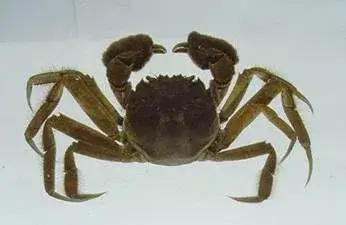
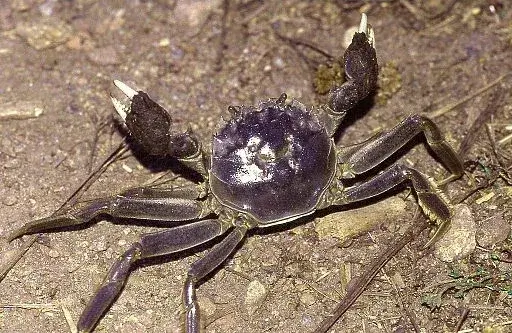
  • Claws equal in size with white tips and “hair”.
  • If you find a crab without hair on the claws, it is NOT likely to be a mitten crab.
  • Carapace up to 4 inches wide; light brown to olive green in color.
  • No swimming legs. This crab has eight sharp-tipped walking legs.

Chinese mitten crab. Note the notch between the eyes and four lateral spines on each side of the carapace. Source: California Department of Fish and Wildlife

Correctly Identifying Mitten Crabs

Small mitten crabs may be confused with the Harris mud crab, because of their similar size and appearance.

Harris Mud Crab Characteristics

  • no notch between the eyes
  • non-hairy, white-tipped claws
  • ridges on back
  • dull greenish-brown color
  • maximum carapace width is 19 mm (¾ inch)

Juvenile Mitten Crab Characteristics

  • notch between the eyes
  • claws may not be hairy if carapace width is less than 20 mm (¾ inch)
  • claws are hairy by 25 mm (1 inch) carapace width
  • four lateral carapace spines (fourth spine is small)
  • smooth, round carapace or body shape
  • legs over twice as long as the carapace width
  • light brown color
person icon with question marks around them
What to do if you Find a Mitten Crab
  • Do not throw it back alive!
  • Freeze the animal, keep on ice, or preserve it in rubbing alcohol, as a last resort.
  • Note the precise location where the animal was found.
  • If possible, take a close-up photo, as above.
  • Photos should be uploaded to iMapInvasives for identification or emailed to isinfo@dec.ny.gov.

REMEMBER THE LAW!

Never transport a live Mitten crab except to deliver to proper authorities.

Mitten crab specimens are needed to confirm sightings, so please follow the instructions above, if you find a mitten crab.

outline of new york state
New York Distribution Map

Additional Information

References

Chinese Mitten Crab Alert for the Hudson River Estuary
New York Department of Environmental Conservation.
Identification/Description; Photographs; Introduction History; Impacts; Habitat

Distribution, Ecology and Potential Impacts of the Chinese Mitten Crab (Eriocheir sinensis) in San Francisco Bay
University of California. Water Resources Center.
Taxonomy; Identification/Description; Photographs; Introduction History; Impacts; Life Cycle; Habitat; Distribution

brown chinese mitten crab with white claws on the ground
Christian Fischer [CC BY-SA 3.0 ], from Wikimedia Commons

Information

Last Updated July 2, 2019